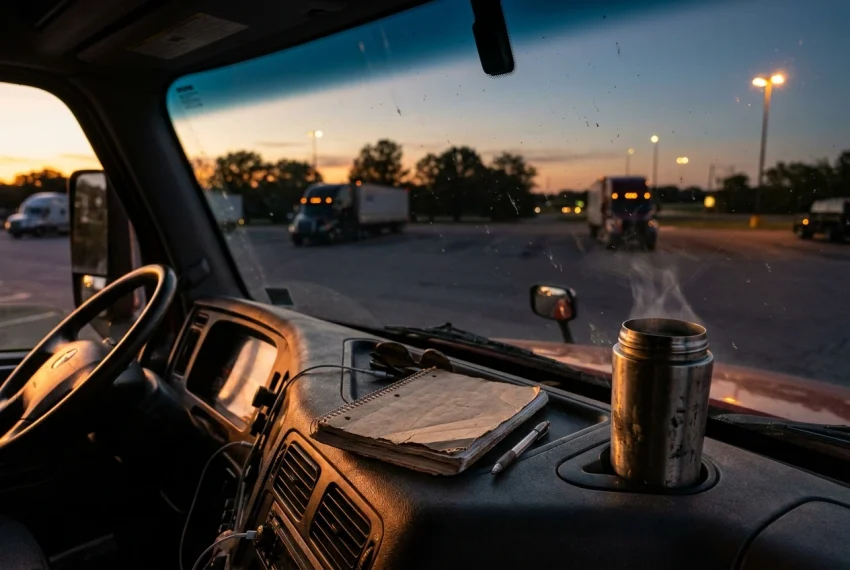
I want to tell you how a habit I picked up to quiet my head ended up as a book with my name on it. Pour a coffee, because this is a conversation and not a lecture.
If you have ever wondered how to turn writing into a self published book, I think the honest answer starts small. It starts with a person who is tired, stressed and needs somewhere to put their thoughts. That was me. I did not set out to build a business.
It Started With Stress, Not a Business Plan
Life on the road comes with a lot of time alone with your own thoughts. Deadlines, miles, weather, bills and everything you are carrying from home all ride along with you. I started writing because I needed to put that noise somewhere other than my own head.
Writing gave my thoughts a place to land. Once something is on a page, it stops circling. You can look at it, argue with it, or just leave it there. For me that was the whole point, and it worked well enough that I kept doing it.
I am not a doctor, and writing is not a treatment for anything serious. If stress is weighing on you heavily, please talk to a professional. But as a simple daily habit that costs nothing and needs no special skill, writing helped me settle down, and I would recommend trying it.
The book came later, once the pages had stacked up and I noticed they had a shape. I am telling you this because many people think a book is only for “real writers” with a degree and a plan. Plenty of useful books start as private pages written by someone who needed to breathe out.
If you work a full time job, raise kids, or spend your days behind a wheel, you already have material. You have things you have learned and seen, and things you wish someone had told you earlier. The question is whether you give those thoughts a place to live.
From Notes on a Page to a Real Book
Here is how I would tell a friend to go from scattered notes to a finished manuscript. None of it needs fancy software, and you can adjust it to your own life.
Collect before you organize
Keep writing without worrying about order. Short entries are fine. A paragraph, a list, or a few lines about a hard day all count. The goal at this stage is volume, because you cannot shape what you do not have.
Look for the pattern
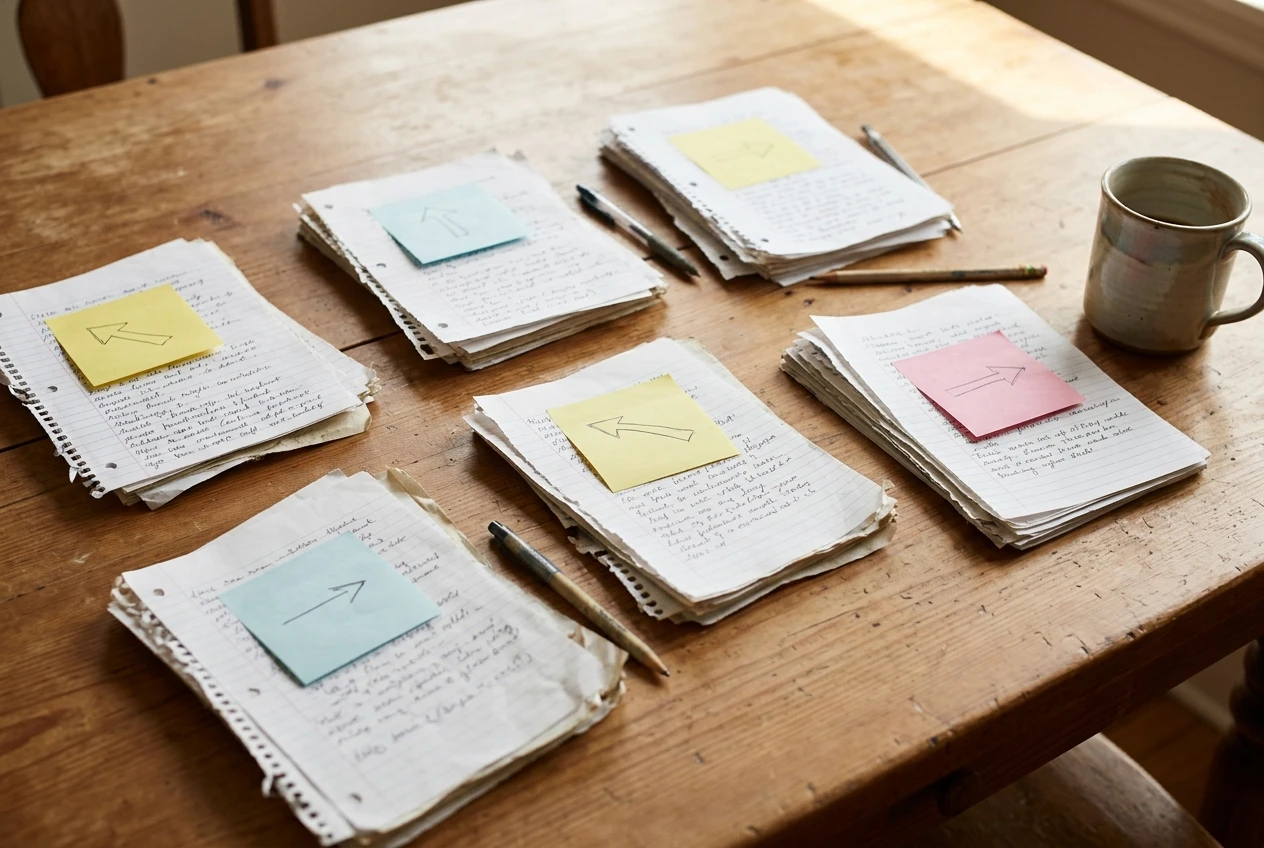
After a while, read back through what you have. You will usually see the same ideas coming up again and again. Those repeating ideas are your book’s subject. Group similar entries together and give each group a working name. Those names often turn into chapters.
Decide who it is for
A book speaks best to one kind of reader. Picture a specific person, such as someone stressed and short on time, and write as if you are talking to them. That keeps the book focused and makes decisions easier later, when you write the description and choose keywords.
Draft, then rest, then edit
Write the full draft without editing as you go. Then leave it alone for a few days. When you come back, you will spot clumsy sentences and repeated points much faster. Read it out loud if you can, because your ear catches what your eye skips.
Get another set of eyes
If someone you trust is willing to read a chapter or two, let them. A reader will notice confusing passages you cannot see because you know what you meant. Take their notes seriously, but remember it is still your book.
None of this is complicated, but it does take patience. A book is built in small sessions, a little at a time, and that is exactly the kind of work people with busy lives can do.
What Publishing for $0 Actually Looked Like
Publishing my book cost me $0, and I want to explain exactly what that means so nobody feels misled.
Amazon KDP, which is Kindle Direct Publishing, does not charge an upfront fee to publish. You create an account, enter your book details, upload your manuscript and cover, set a price, and submit. Paperbacks are print on demand, which means a copy is only printed when someone orders it. You do not buy a stack of books and store them in a closet.
When a copy sells, the printing cost is taken out of the sale price and the rest is your royalty. That is why the up front cost can be zero: the production cost comes out of each sale instead of out of your pocket beforehand.
Here is what I mean by $0, and where the limits are:
- KDP offers a free ISBN if you want to use theirs, and it has a built in cover tool if you do not have a designer.
- You can upload your own cover and formatted manuscript if you prefer a different look.
- If you order author copies for yourself, you pay the printing cost for those, so that is a choice and not a requirement.
- If you decide to hire an editor or a cover designer, that costs money. It is optional, and I am not telling you it is a bad idea. I am telling you it is not required to get a book onto the store.
I would also say that publishing for free does not mean the work is free. You pay with your time and your attention. Editing, formatting and checking the proof copy all take effort. A book that goes out with obvious mistakes reflects on you, so take your time before you press the publish button.
If you want the full walkthrough of the tools and the process, I wrote a separate guide: how to become a self-publisher, step by step, using the tools I use every day. This article is more about the story and the mindset.
Fine Tuning Amazon KDP Keywords and Why It Mattered to Me
I did not run paid ads for this book, so search mattered a lot. A stranger browsing Amazon cannot buy a book they never see, and a search box is one of the main ways a book gets seen. That is why I paid attention to the keywords.
When you set up a book on KDP, you get seven keyword boxes. Each one takes a word or short phrase that tells Amazon what your book is about and what a reader might type to find it. Many new authors fill those boxes quickly, or leave some of them empty. That is a missed opportunity, because those boxes are free.
Here is how I would approach it, based on how search works:

- Think like the reader, not the author. You know your book’s title and your own words for it. A shopper does not. Ask yourself what a stressed, tired person would type into the search bar when they want what your book offers.
- Use the Amazon search bar itself. Start typing a phrase related to your topic and look at the suggestions that appear. Those suggestions come from what people actually search for.
- Use phrases, not only single words. A short phrase such as “stress relief journal for adults” tells Amazon far more than the single word “stress.” Keep each phrase relevant to what the book actually delivers.
- Do not repeat words you already used in your title. The title is already searched, so your keyword boxes are better spent on different phrases that add reach.
- Never use another author’s name or a misleading term. It breaks the rules and it sends the wrong readers to your book, who will leave disappointed.
- Review them later. Your first choice is a guess. Come back after some time, look at how the book is doing, and adjust.
Why did this matter to me personally? Because with no advertising budget, I wanted every free tool working for the book. Keywords, a clear description and a fitting category cost nothing, and they are all part of how a book gets discovered. I cannot promise that any specific keyword brings you sales, because I do not know your topic or your competition. What I can say is that ignoring them leaves free visibility unused.
The same logic applies to your own website. If you write articles, search is how people find them. Choosing words your reader actually types is a skill that carries across KDP, blogging and anything else you publish online.
77 Paperbacks, CA$412, and Honest Expectations
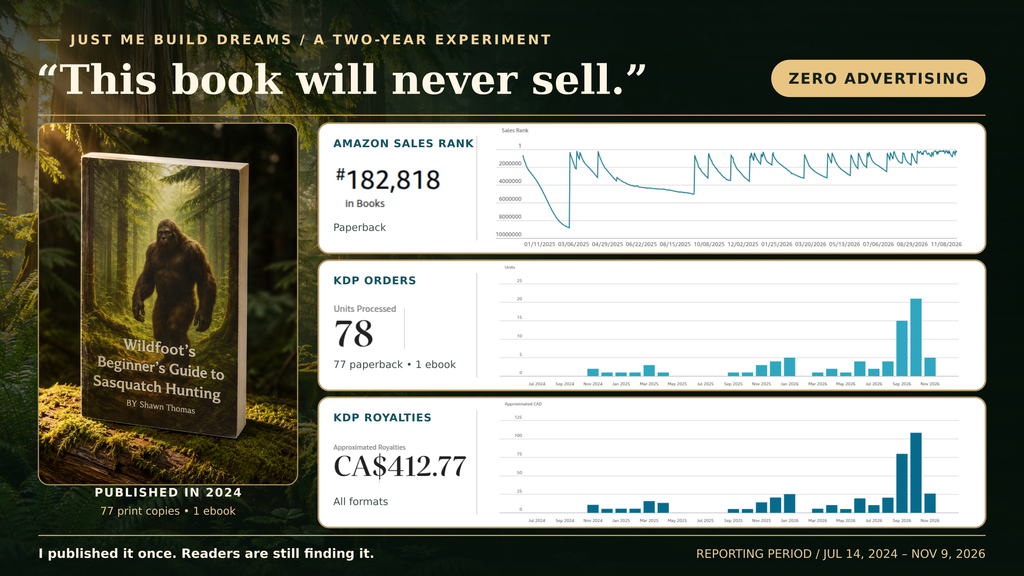
Now the numbers. I would rather give them to you plainly than hint at something bigger.
Over two years, this book sold 77 paperbacks and earned CA$412 in royalties. I did not run any paid ads. That is the entire result.
I know how that sounds next to the screenshots people post online. It is not a salary, and it will not cover a mortgage. I am not going to dress it up as something it is not, because that would not help you and it would not be honest.
Here is how I look at it instead:
- Each sale was a real person. Seventy seven people chose to buy something I wrote. When I think about it that way, the number means a lot more than the dollar amount.
- The book cost nothing to put out. Because publishing cost $0, every royalty dollar was extra. There was no cost to earn back first.
- The book kept being available. It did not need me to be awake, on shift, or even thinking about it. It sat in the store, and people kept finding it.
- The result came slowly. Two years is a long time, and the earnings came in small amounts. If you expect quick money from a first book, you will be disappointed. If you expect a small, slow return that may grow, you will be in a better frame of mind.
I want to be careful here. Your results will be different from mine. Another author with a different topic, a different audience and a different cover could sell far more, or far less. Nobody can promise you a number, and you should be wary of anyone who does. Royalties can also be taxable income, so keep records and check the rules where you live.
What I can say is that a book is something you build once and that can keep earning a little in the background. I think of it as a digital asset. It is a piece of work that sits online, and every so often someone buys a copy. Some books earn more over time and some earn almost nothing, and no one knows which one yours will be until you try.
If you want to see how this fits into the bigger picture of building something online as a person with a full time job, I wrote about that in What Do You Really Think It Takes to Build Something Online?. The same message runs through both pieces: patience and steady effort matter more than speed.
A Little Sidekick Working Alongside You, Plus the Legacy You Leave Your Family
I like to think of a published book as a little sidekick. It does not replace your job, and it does not ask for much attention. It sits in the store while you drive, work your shift, help with homework or sleep. Every so often it makes a sale and reminds you it is there.
That is a very different feeling from most work. Most of us trade hours for pay, and when we stop, the pay stops. A book is not a guarantee of anything, but it can earn without you standing next to it, and that is a quiet kind of encouragement when your days are full.
There is a second thing I have come to value even more than royalties, and it is the legacy part.
A book with your name on it is something a family can keep. Your thoughts, your lessons and your way of explaining the world stay on a shelf, in a library, or in a digital file. Years from now, someone you care about can pick it up and hear how you thought. A text message or a social media post rarely lasts that long, but a book can.

You do not need a famous name or a big audience for that to matter. The reader who matters most might be one person in your own family who someday wants to know what you were like. Even if you never sell a single copy to a stranger, ordering one paperback for someone you love gives them something real to hold.
So here is what I would say to anyone with a stack of notes and a lot of doubts:
- Start with the stress, because that is real material.
- Write a little each day, even a few lines.
- Shape the notes into chapters when you are ready.
- Publish carefully, using the free tools available to you.
- Be honest with yourself about money, and treat any royalties as a bonus.
- Keep the long view, because the legacy outlasts the sales numbers.
You can do this alongside a full time job. I did, and I still do.
Your Next Page
If this story landed with you, I would like you to take one small step. Browse around my website and see what else is there for people building something of their own. Then read my story as an author and what I learned about making money from books, which goes deeper into the journey and the lessons behind it.
Then open a notebook or a blank document and start creating your own book, one honest page at a time. You do not have to know how it ends. You only have to write the first page.