
If you’ve ever thought about becoming an author or publishing your own book, I want to walk you through the exact process I use.
This isn’t theory. This is what I’ve personally done to build 16 books on Amazon, 13 audiobooks, and continue expanding into new publishing directions. Everything here is simple, repeatable, and built for long-term growth.
The key is not just writing a book. The key is building something around it.
Let’s walk through it step by step.But first I’ll tell you what tools I use and at the end of the blog I’ll share why!!
- Step 1: Lock In the Book Idea, Title, and Direction
- Step 2: Set Up Your Writing and Formatting Tools
- Step 3: Write and Build Your Book
- Step 4: Format Your Book Using Reedsy
- Step 5: Publish Your Book on Amazon KDP
- Step 6: Use Tools That Help You Move Faster (Optional but Powerful)
- Step 7: Build Your Home Base (Where Everything Connects)
- If You Want to Check It Out
- Step 8: Start Driving Traffic (The Slow Process That Works)
- Final Thoughts: From the Driver’s Seat to the Author’s Shelf

These are the core tools I use every day to build and publish my books:
ChatGPT, Canva, Wealthy Affiliate, Reedsy, and Amazon KDP.
That’s it.
With just these five tools, you can go from idea to fully published book without overcomplicating the process. Everything works together, and once you understand how each piece fits, the whole system starts to make sense.
Right now, this setup costs me about $180 per month total, and that covers everything I need to write, format, publish, and market my books.
In the next steps, I’m going to walk you through each tool one by one and show you exactly how they fit into the process of becoming a self-publisher.
Step 1: Lock In the Book Idea, Title, and Direction
Before anything else, you need to get clear on what you’re actually creating.
This is your starting point, and honestly, it’s one of the most important parts of the entire process. A lot of people rush this and just start writing, but if you slow down here and think it through, everything becomes easier later.
| Question | Example / Direction like I did |
|---|---|
| What kind of book do you want to write? | Non-Fiction (Bigfoot encounters, paranormal stories) or Non-fiction (guides, personal experiences, research-based topics) |
| What topic are you interested in? | Sasquatch, survival, affiliate marketing, personal journey, paranormal, storytelling, or teaching others something you’ve learned |
| What kind of reader are you trying to reach? | Curious beginners, experienced researchers, outdoor enthusiasts, entrepreneurs, or people looking for real-life stories and deeper ideas |
This is where you begin identifying your niche, your category, and your genre.
You also want to start thinking about your title early. It doesn’t have to be perfect, but it needs direction. Titles help guide the content, and they also play a big role when your book is sitting on a platform like Amazon.
What I like to do is write down a few variations of the idea, different angles, and possible titles. From there, I narrow it down into something that feels strong and clear.
| Category | Example (One of my Books) |
|---|---|
| Book Idea | A deep exploration of why Bigfoot continues to exist across generations, blending real encounters, cultural memory, eyewitness accounts, and unexplained patterns |
| Core Concept | Bigfoot isn’t just a creature, it’s a repeating phenomenon tied to history, land, and human experience |
| Possible Titles | The Big Questions of Bigfoot: How Does Bigfoot Endure? Why Bigfoot Still Exists The Legend That Refuses to Die |
| Niche | Bigfoot / Cryptids / Paranormal / Real Encounters |
| Target Reader | People who are curious about Sasquatch, open to deeper theories, and interested in real stories rather than surface-level explanations |
| Reader Emotion | Curiosity, tension, wonder, and that feeling of “something isn’t adding up” |
| Angle | Instead of trying to prove Bigfoot exists, the book explores why the pattern never disappears |
| Unique Hook | Focus on patterns, generational stories, and real-world consistency instead of just sightings |
| Content Style | Story-driven, research-backed, reflective, and immersive, built like a journey through the unknown |
| Authority Builder | Based on real conversations, long-term interest, and collected patterns from witnesses and history |
| Big Question Driving the Book | If Bigfoot isn’t real… why do the same experiences keep happening across time and geography? |
| Series Potential | Can expand into multiple books exploring specific angles like encounters, theories, locations, and high strangeness |
This step is bigger than just one book.
This is where you start thinking about the brand behind the book. Because if you do this right, your book isn’t just a one-time project. It becomes part of something you can build on.
Step 2: Set Up Your Writing and Formatting Tools

Once your idea is locked in, now it’s time to set up the tools you’re going to use.
The good news is, you don’t need to spend money here.
The first thing I recommend is creating a free account on Reedsy. This is the tool I use to format my books, and it’s incredibly simple to work with. There is a paid version, but you don’t need it to get started.
Next, you’ll want a place to write your book. You can use Google Docs, which is completely free and works great for writing, saving, and organizing your content.
What I used to do was write everything inside Google Docs and then upload it into Reedsy once it was finished. Now, I often skip that step and write directly inside Reedsy itself.
Either way works.
The important thing is that you now have your system ready. You have a place to write, and you have a place to format. That’s all you need to begin.
Step 3: Write and Build Your Book

Now comes the part where most people either move forward… or stop completely.
You need to write.
Not perfectly. Not all at once. Just consistently.
Start building your chapters one by one. Focus on getting your ideas out instead of trying to make everything sound perfect on the first pass. You can always go back and clean things up later.
If you’re writing in Google Docs, keep it organized. If you’re working inside Reedsy, start structuring your chapters as you go.
This is where momentum matters more than anything else.
The people who finish books are not the ones who are the most talented. They’re the ones who keep showing up and building, even when it’s not perfect.
Step 4: Format Your Book Using Reedsy

Once your manuscript is written, this is where Reedsy really comes into play.
If you wrote your book in Google Docs, you can upload it directly into Reedsy and it will automatically organize your chapters and content.
From there, you can adjust spacing, structure, headings, and layout so that your book looks clean and professional.
This step is important because presentation matters. When someone opens your book, you want it to feel like a real product, not something thrown together.
Reedsy handles this without needing to hire a formatter or spend extra money.
Step 5: Publish Your Book on Amazon KDP
With your book written and formatted, you’re ready to publish.
Amazon KDP is the platform I use, and it’s completely free to get started.
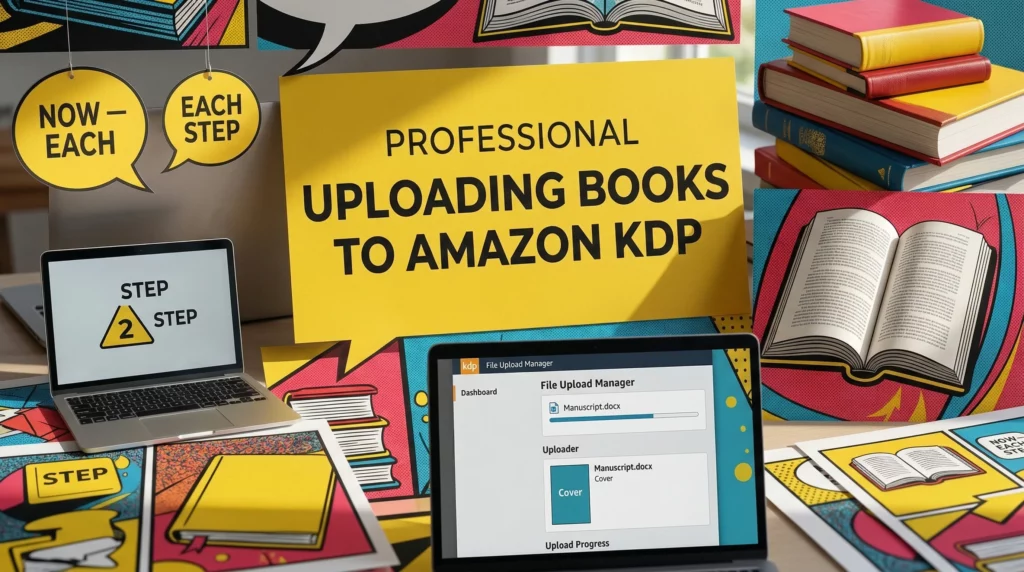
You’ll upload your manuscript, your cover, write your description, choose your categories, and set your pricing. Once everything is submitted and approved, your book goes live.
This is where you officially become a published author.
But it’s important to understand something here.
Publishing is not where the work ends.
It’s where it begins.
Step 6: Use Tools That Help You Move Faster (Optional but Powerful)
Everything up to this point can be done for free.
But if you want to move faster and stay consistent, there are tools that can help.
I personally use ChatGPT, which is around thirty dollars a month. It helps me structure ideas, break through writer’s block, and stay productive when I’m building multiple projects at once. they too have a free version.
This isn’t required, but it can make a big difference when you’re trying to scale. still get a free account!
Step 7: Build Your Home Base (Where Everything Connects)

This is where everything starts to level up.
Once your book is live, you need somewhere to send people. Not just a link… a place that actually represents you.
For me, that place is my website.
This is where your books live.
This is where your ideas expand.
This is where your brand actually starts to take shape.
Instead of relying only on Amazon, you now have something that belongs to you.
And that shift right there?
That’s where long-term growth begins.
Now I’ll be straight with you…
I don’t just build websites anywhere.
I run everything through Wealthy Affiliate. 👇

And I say that because this platform isn’t just hosting.
It’s the foundation.
👉 It’s where I learned how to build my sites
👉 It’s where I run them securely
👉 It’s where I learned how to actually drive traffic
👉 And it’s where I connected with people doing the same thing
When you’re starting out, you don’t just need tools.
You need:
- A secure platform
- A place to learn
- A community that actually answers questions
- And a system that shows you how to grow
That’s what this gives you.
Real Talk
This is my belt buckle tool.
This is what runs the entire engine for me.
Every blog, every piece of traffic, every book push…
It all connects back here.
If You Want to Check It Out
They offer a 7-day free starter experience, so you can explore it yourself and see how it works.
No pressure, just go look around and see if it fits what you’re trying to build.
- 👉 This is where you stop guessing
- 👉 This is where you start building something real

“People Also Ask” (PAA) Questions
- “How much does it actually cost to self-publish a book in 2026?”
- Why this works: You already mentioned your $180/month overhead. Answering this directly in a FAQ section or a sub-heading helps you grab people looking for “budget self-publishing.”
- “Do I need an ISBN to sell my book on Amazon KDP?”
- Why this works: This is a technical hurdle that stops many beginners. You can briefly explain that KDP provides a free one, or mention the free Canadian ISBNs (since you’re in Alberta) to add local value.
- “Is Amazon KDP still profitable for new authors in 2026?”
- Why this works: There is a lot of “is it dead?” talk online. Your success with 16 books is the perfect “proof of life” for this answer.
- “How do I format a book for free without hiring a professional?”
- Why this works: This leads perfectly into your Step 4 about Reedsy. It targets the “DIY” crowd who are afraid of high upfront costs.
Step 8: Start Driving Traffic (The Slow Process That Works)

Now you have everything in place.
Your book is published. Your website is live.
Now you need people.
This is where you start leveraging free, organic traffic.
Platforms like Pinterest, Facebook, and other content channels can slowly bring people into your world. This part takes time, and it’s not instant, but it works if you stay consistent.
You create content, you share your ideas, and you lead people back to your website, where your books are waiting.
Over time, this builds momentum. Read my blog see the numbers.
Final Thoughts: From the Driver’s Seat to the Author’s Shelf
I want to be completely straight with you: I didn’t build these 16 books and multiple brands from a fancy home office.
I built this entire system while working a full-time job behind the wheel of a truck.
I’m still out here, putting in the miles and hauling loads every single day. If I can find the time to build a publishing empire from a truck cab, I promise you, anyone can do this. You don’t need a degree in English or a massive bank account you just need the willingness to follow a proven process.
I didn’t build Wildfoot Explores and my other projects just to see my name in print. I built them to secure a better future and to show people that you don’t have to settle for just one paycheck.
If you’re tired of “someday” and you’re ready to start earning for your future, this is your roadmap. Follow the steps, read the blogs, and take that first small action today.
The road is open. I’ll see you on the inside.